Sunday, January 9, 2011

CSB #4 How Old Is Your Cancer?

Cancer
  • Prognosis - The likely course of a disease or ailment
  • Pancreas - A large elongated exocrine gland located behind the stomach
  • Cancer - The uncontrolled growth of abnormal cells in the body
Summary
When a person is diagnosed with pancreatic cancer, the person has 5% chance of surviving once it has been diagnosed. This is because the cancer is usually diagnosed 15 years after the first cancer-causing cells appear. What the model says is that cancer cells appear ten years after the first cancer-causing mutation and then another five years pass before the cancer cells actually spread and become deadly. For the past two years, scientists have been bringing pancreatic cancer screening closer to reality. Scientists have found four RNAs in saliva of 60 treatable pancreatic-cancer patients and 30 cancer-free individuals. that can correctly identify cancer 90% of the time. These technologies are not commercially available but they will progress greatly in the near future.

Discussion


I think this article is interesting and important for everyone. This is especially useful for people who believe that they have pancreatic cancer because this will reduce the chance of death. If this technology is perfected then scientists  and doctors can see if a person has cancer and can easily provide treatment or remove the mutation before the cells become fatal and kill the person. Scientists should be aware of this because it can severely help people if this is perfected quickly. 


Questions

  • Could this also help scientists find cancers in different parts of the body before they are deadly?
  • How long will this take to be allowed to be used commercially and how much will it improve?
Citations
  • Moyer, Melinda Wenner. "How Old Is Your Cancer?" Scientific America. N.p., n.d.
         Web. 9 Jan. 2011. <http://www.scientificamerican.com/
         article.cfm?id=how-old-is-your-cancer>.
  • http://www.scientificamerican.com/article.cfm?id=how-old-is-your-cancer

Thursday, November 18, 2010

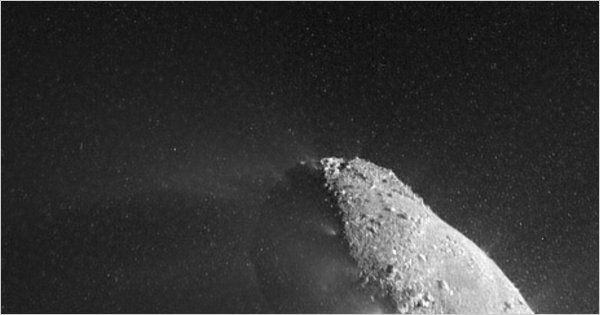
CSB #3 Comet Hartley 2 is Spewing Ice

Definitions

  • Comet: a relatively small extraterrestrial body consisting of a frozen mass that travels around the sun in a highly elliptical orbit
  • NASA: The National Aeronautics and Space Administration; Their self-described mission is to "pioneer the future in space exploration, scientific discovery, and aeronautics research.
Summary
Hartley 2, a peanut shaped comet, is spewing out tons of fluffy ice chunks every second since the Deep Space spacecraft flew by it. The most fascinating thing about this comet is that the ice and water chunks were not being lifted off by the force of water vapor, but rather by jets of carbon dioxide. This is the first time that carbon dioxide has been observed doing this. Also, because water stays frozen longer than dry ice, the carbon dioxide blows it off while it is still solid. Although there were bright specks in the images, the spacecraft did not suffer any damage when it flew through the storm at 27,000 miles an hour. The scientist from NASA believe, from the absorption of the light, the chunks were more like a dandelion puff with air in the middle and can be easily broken. The carbon dioxide that is frozen would have to be very old to be frozen in the comet. This has never been found in a previous case with comets.
Discussion
I find this interesting that this has never been found in another comet. This may help us in finding water on other planets. I find it interesting how the carbon dioxide will push off the ice and water chunks.
Questions

  • Could we harvest these comets as a water source?
  • Could this help us find water on other planets?
Citations
Chang, Kenneth. "Surprise at a Comet Visited by NASA: A Snowstorm." The New York 
     Times: n. pag. Web. 19 Nov. 2010. <http://www.nytimes.com/2010/11/19/
     science/space/19comet.html?_r=3&partner=rss&emc=rss>.
http://www.nytimes.com/2010/11/19/science/space/19comet.html?_r=3&partner=rss&emc=rss

Thursday, October 14, 2010

CSB #2 Plug-in Cars Pose Riddles for E.P.A.

Definitions
  • E.P.A. = Environmental Protection Agency
Summary
  • Chevrolet Volt and the Nissan Leaf are awaiting the thumbs up from the E.P.A. before their production and sales
  • The Volt runs from 25 to 50 miles on battery before the engine kicks in and the Leaf is an entirely electric car
  • Nissan is does not know what it is expecting from the E.P.A. but something in the range of miles per kilowatt hour and Chevy is expecting multiple fuel-ecomoney figures based on distance driven between battery charges
  • E.P.A. is expecting that it will not come up with an official way to grade these cars until 2012
  • The Volt will have a 310 miles when it depletes the battery which will make it 33.3 miles to the gallon
  • The Volt became a source of debate because testers say that the Volt will, at high speeds, drain the battery quickly and use the gas engine to propel itself, making this the normal hybrid.
  • G.M. describes the Volt as the engine powers a generator not the wheel
Discussion
  • I believe that is it is interesting how new cars are are changing the way that E.P.A. has to look and grade them.
  • These cars have started a revolution from coming from hybrid to full electric
Questions
  • How will E.P.A. start to grade these cars and how will they tell which cars are good and which ones are bad?
  • How long is it until we switch from gasoline cars to electric?
Citations
Bunkley, Nick, and Bill Vlasic. “Plug-In Cars Pose Riddle for E.P.A.” The New York Times: n. pag. The New York Times. Web. 15 Oct. 2010. <http://www.nytimes.com/‌2010/‌10/‌15/‌business/‌energy-environment/‌15auto.html?_r=1&partner=rss&emc=rss>.
http://www.nytimes.com/imagepages/2010/10/15/business/15auto.html

Thursday, September 23, 2010

CSB #1 WHO declares end to H1N1 Pandemic

Definitions:
  • WHO - World Health Organization
  • influenza - an acute febrile highly contagious viral disease
Summary:
  • WHO has declared an end to the H1N1 pandemic is finally over
  • Out of season H1N1 outbreaks are no longer being observed
  • The virus has not entirely disappeared, the intensity just has gone down
  • Although the intensity has gone down, WHO still recommends high caution with this virus
  • The CDC recommends vaccinations, everyday actions to prevent the virus, and correct use of anti-viral drugs if recommended by a doctor
Discusion
    • I think its interesting how pandemics with the flu even occur out of "season" and cause pandemics with them
    • The patterns with the influenza may help scientist predict more out breaks
    Questions
    • Why do pandemics stop and start following the regular season?
    Sources
    • US Department of Health & Human Services. “WHO Declares End to 2009 H1N1 Influenza Pandemic.” US Department of Health & Human Services. N.p., n.d. Web. 24 Sept. 2010. <http://www.hhs.gov/‌news/‌press/‌2010pres/‌08/‌20100810b.html>.
    • http://www.vaccines.mil/documents/images/swine_flu.jpg